CCaaS Migration in the Age of Agentic AI
Large enterprises are being forced to become early adopters. Migrating to CCaaS in the agentic AI era is not a technical refresh. It is the foundation of your future customer experience.
Every CX provider is racing to own the AI layer. Two recent acquisitions reveal exactly what has been missing from most CCaaS platforms: an outcome orchestrator that can actually complete the work.
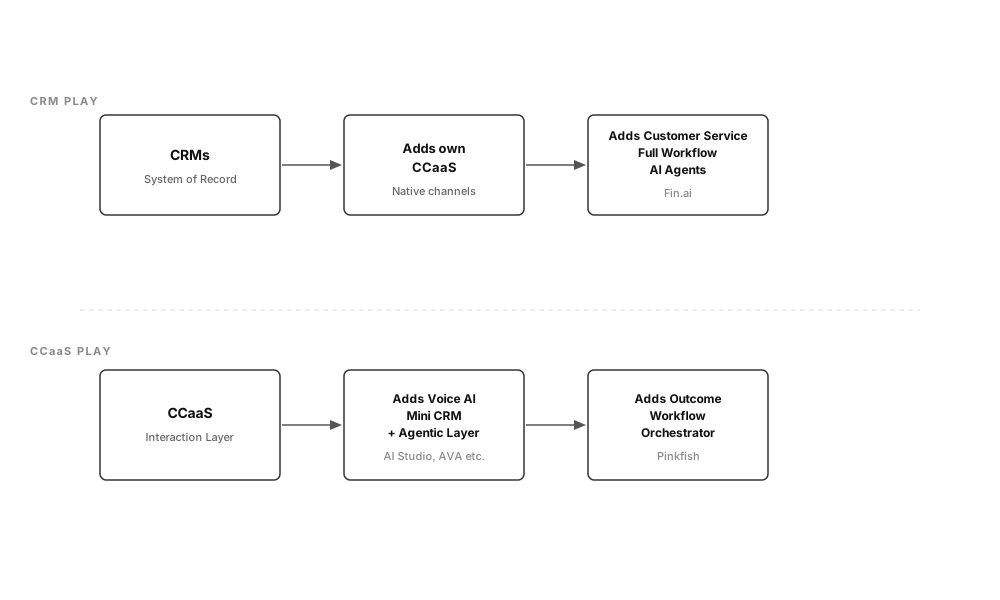
Every CX provider is in a race to own the AI layer. And CX sits at the center of almost every innovative approach emerging right now.
Voice AI/Applied AI continue to be the control plane of customer experience. We have seen agentic advancements accelerating across the board. But there has been a structural gap that most platforms have been quietly navigating around.
CCaaS platforms had almost everything. Routing. Orchestration. Omnichannel. Workforce management. Analytics. Recently Voice AI. But the one thing missing was an outcome orchestrator, a layer that could actually execute the work end to end across enterprise systems.
Acquisitions in the CX industry have always been interesting to watch. They reveal strategic gaps more honestly than any product roadmap does, and also show where consumers are heading. When a platform spends real money to acquire a capability, it is telling you what they could not build fast enough on their own, and what they believe the market is about to demand.
Two recent deals make this point clearly. Salesforce's agreement to acquire Fin.ai, and Genesys's completed acquisition of Pinkfish, are both bets on the same strategic shift: customer service AI is moving from answering questions to taking governed action across enterprise systems.
But the two buyers are solving different gaps.
Salesforce is acquiring a scaled, high-performing customer agent and vertical AI stack to strengthen Agentforce in service workflows, particularly where customers want faster deployment and measurable resolution outcomes. The gap Salesforce is closing is execution speed and vertical depth. Fin brings proven AI resolution performance at scale, which gives Agentforce Contact Center a credible answer to enterprises asking not just "can your AI handle this?" but "can it resolve it at the rate we need?"
Genesys entered the Pinkfish deal from a position of strength. Nearly $2.6 billion in cloud ARR, close to $3 billion in total FY2026 revenue, and a platform that already included AI Studio, AI Guides, and an Agentic Virtual Agent powered by large action models.
The Genesys AI story was already coherent. AI Studio as a no-code, guardrailed hub for building and governing agentic AI. Agentic Virtual Agent as a reasoning and execution layer that can handle off-script scenarios across channels. The agent brain and governance shell were already in place.
What Pinkfish added was execution depth.
Genesys had the virtual agent. It had the governance model. What it needed was a denser action fabric, a mature tool ecosystem that could connect customer intent to governed actions across the messy enterprise back-end systems that actually exist in large organizations.
Pinkfish is purpose-built for exactly that. It is MCP-native, built around tools, connections, and workflows rather than consumer-style chatbot abstractions. Its MCP Farm, connection and credential model, custom MCP generation from OpenAPI, workflow monitoring, and wide third-party coverage give Genesys a governed tool-use runtime, something that meaningfully widens what Genesys Cloud agents can actually do once they understand a customer request.
The result is that Genesys AVA can now credibly answer the hardest enterprise question in agentic CX: "Can your AI system safely do the work across all the back-end systems we actually have?"
Verifying an order. Applying a credit. Upgrading a shipment. Notifying the customer. All of it, end to end, without a human in the loop for routine cases.
CCaaS sits at the interaction layer, voice, chat, email, SMS, WhatsApp, video. Applied AI and Voice AI operate as the control plane, handling intent, reasoning, planning, memory, and policy.
But in between customer intent and enterprise execution, there has always been a gap. The outcome orchestrator, the layer that handles business state, AI decision execution, enterprise workflow, governance, and outcome completion, has been the missing piece.
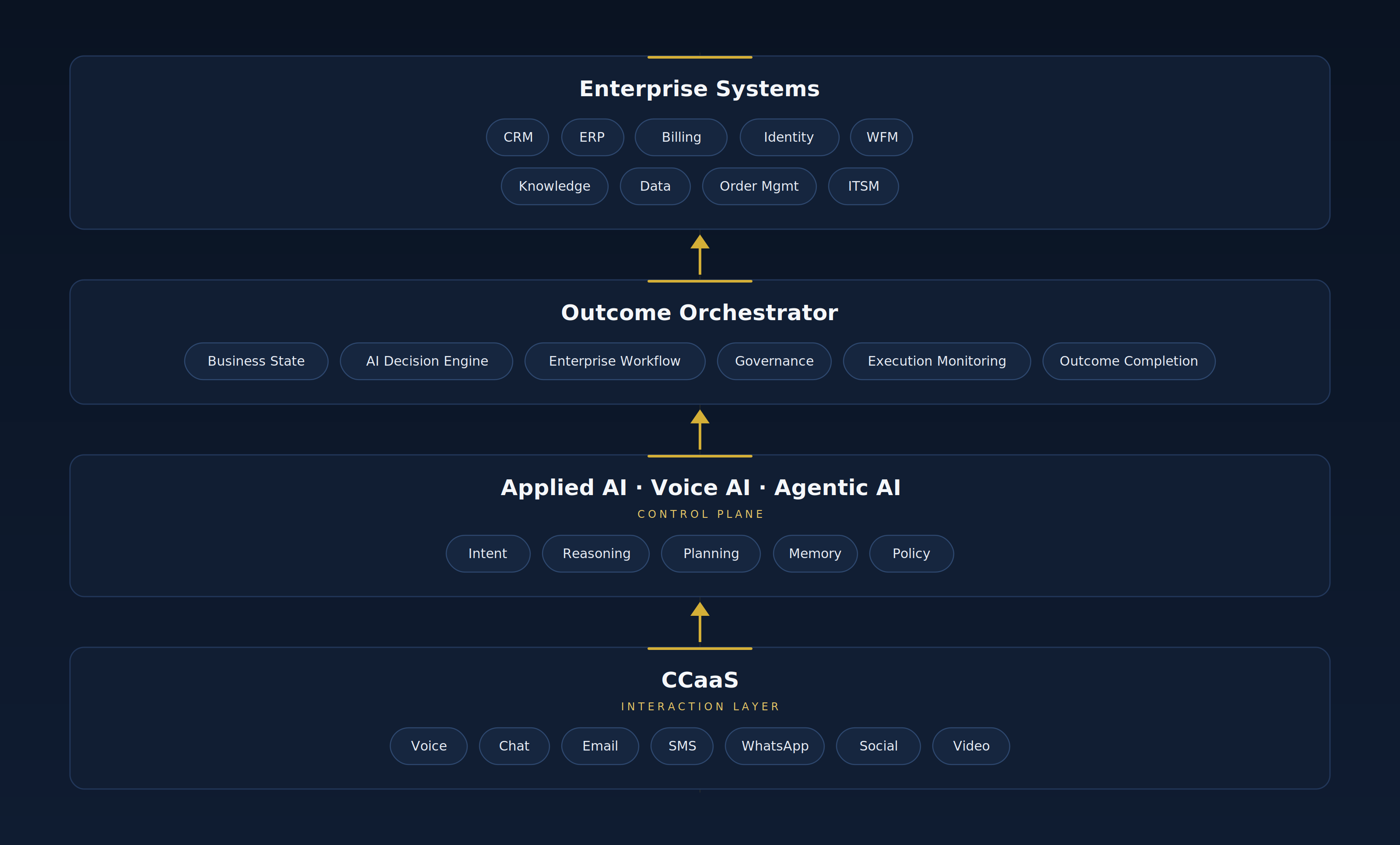
Most platforms conversed with customers. Fewer could complete work for them.
That is the gap these acquisitions are directly addressing. And it is the right gap to close. Because in an agentic AI world, conversational quality alone is no longer a differentiator. What separates platforms now is whether the AI can actually finish the job.
If you are evaluating CCaaS platforms right now, the question has changed.
It used to be: which platform has the best routing, the best omnichannel, the best reporting?
Now the question is: which platform has the most credible path from customer intent to resolved outcome, across my actual enterprise systems, with the governance my compliance team requires?
The platforms that can answer that question, with real capability behind the answer, are the ones that will win the next generation of enterprise CX consolidation.
The acquisitions tell you who understands this. The roadmaps will tell you how fast they are moving. And your own integration complexity will tell you which one fits your environment.
CCaaS was always the interaction layer. Applied AI became the control plane. The outcome orchestrator is the missing layer that completes the circle.
The industry is building it now. The organizations that architect for it today will not be scrambling to catch up in two years. The ones that treat this as a future consideration will find themselves explaining to their boards why their AI agents can understand customers but cannot complete work for them.
The circle is being completed. The only question is whether your platform strategy is keeping up.
Large enterprises are being forced to become early adopters. Migrating to CCaaS in the agentic AI era is not a technical refresh. It is the foundation of your future customer experience.
Genesys hits $2.8B ARR, Salesforce crosses the CCaaS line, NICE goes native with agentic AI, and a $670M government deal confirms who still wins mega-enterprise procurement.