Completing the Applied AI Circle in CCaaS
Every CX provider is racing to own the AI layer. Two recent acquisitions reveal exactly what has been missing from most CCaaS platforms: an outcome orchestrator that can actually complete the work.
Large enterprises are being forced to become early adopters. Migrating to CCaaS in the agentic AI era is not a technical refresh. It is the foundation of your future customer experience.
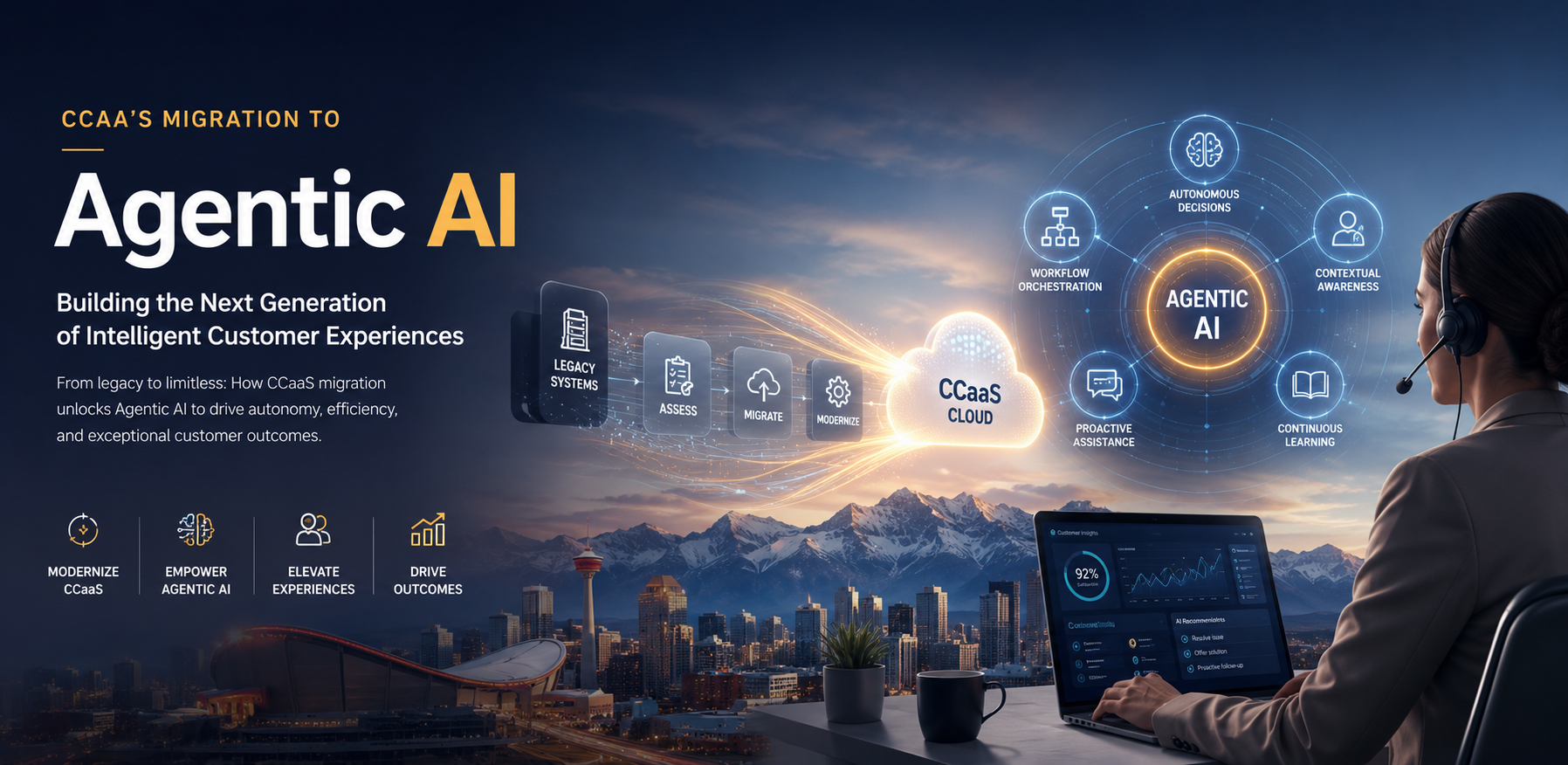
We still have a huge set of mid to large enterprises running legacy on-premise contact centers, navigating one of the most important transitions in their history.
Every hyperscaler and CRM platform has now got onto the CCaaS bandwagon in some shape or form.
Voice agentic AI adoption is accelerating across almost every customer segment. Startups and digital-native companies are moving fast. Mid-market organizations are experimenting boldly.
But many large enterprises, especially those with deep on-premise investments, are not natural early adopters.
And yet they are now being forced to become one.
Thanks to the GPT innovation wave, AI accelerators, rapid ecosystem maturity, and most importantly, Gen Z customers who expect speed, autonomy, and intelligence by default.
This shift is no longer optional. It is being forced across every avenue.
Migrating to CCaaS in the agentic AI era is not just a technical refresh. It is the foundation of your future customer experience, a structural, operational, and cultural transformation.
Here are the most common pitfalls I have observed and the focus areas that actually move the needle.
Many organizations approach cloud migration as infrastructure modernization.
"Move what we have today to the cloud first, and we will bring AI later."
"We have 12 months to do this. Let's do like for like."
That mindset is outdated.
CCaaS migration is not about replicating legacy IVRs, queue structures, and routing logic in a new hosting environment. It is about redesigning the experience architecture and setting the right foundation for future AI adoption.
If you simply port 15-year-old call flows, siloed routing models, and channel fragmentation, you have only moved technical debt to a subscription model.
Focus instead on journey-first architecture, intent-based routing, AI-native orchestration, and an automation-first service model.
Cloud is not a new data center. It is a new operating model.
Large enterprises built their contact center ecosystems over decades.
You will often encounter telecom-heavy governance, security risk aversion, long procurement cycles, and internal teams protecting legacy systems. These organizations were not built to pivot at startup speed.
But consumer expectations now operate at startup speed. That creates real internal tension.
Focus instead on executive-level AI vision alignment, clear articulation of business outcomes around cost-to-serve, containment, and CSAT, structured change management, and early involvement of InfoSec and compliance teams.
Cloud adoption without organizational readiness will stall mid-flight.
Agentic AI is only as powerful as the data it can access.
I have seen organizations invest heavily in conversational AI pilots while CRM data is fragmented across too many billing systems, knowledge bases are outdated, interaction history is siloed, and analytics maturity is low.
You cannot layer intelligence on top of chaos.
Focus instead on a clean CRM integration strategy, a unified interaction data model, a knowledge governance process, and real-time API orchestration capabilities.
Data readiness should precede AI ambitions.
The CCaaS market is noisy. Native AI capabilities, third-party orchestration layers, workforce optimization tools, analytics overlays, automation engines. Enterprises often over-index on feature comparison instead of architecture alignment.
This results in redundant capabilities, integration complexity, and escalating operational costs.
Focus instead on defining your target operating model first, choosing platforms aligned to that model, minimizing custom integration unless strategically required, and ensuring extensibility for future AI modules.
Architecture discipline matters more than feature checklists.
AI is not just changing customer experience. It is redefining the role of agents.
In many of the organizations I have worked with, agents are worried about job displacement, supervisors lack AI governance clarity, and training programs are outdated.
The most successful migrations position AI as agent augmentation, a cognitive co-pilot that helps handle complex conversations with ease, a real-time guidance engine, and an after-call automation accelerator.
Focus instead on redefining agent skill models, introducing AI literacy programs, implementing human-in-the-loop governance, and aligning WFO transformation with the CCaaS roadmap.
The workforce transition is as important as the technology migration.
When evaluating transformation investments, leaders often compare cloud subscription costs, migration services, and AI licences. But they rarely quantify the cost of inaction, customer churn risk, brand erosion among digital-native consumers, operational drag from legacy systems, and the inability to deploy AI at scale.
The real ROI is not just platform efficiency. It is strategic relevance.
The comparison becomes:
Stay on-premise: high infrastructure overhead, slow innovation cycles, limited AI extensibility, rigid scaling.
Cloud and AI-ready CCaaS: elastic scalability, embedded AI services, faster innovation velocity, continuous platform evolution, competitive differentiation.
When framed this way, the migration conversation shifts from a cost discussion to a future-proofing strategy. And that is when executive buy-in accelerates.
The biggest forcing function is not technology. It is the customer.
Gen Z and digital-native consumers expect instant resolution, prefer asynchronous channels, tolerate zero friction, expect intelligent self-service, and compare your experience to the best digital brands, not your industry peers.
If your on-premise contact center cannot support AI-native self-service, cannot deliver proactive engagement, and cannot scale digital channels seamlessly, then migration is no longer a technology project.
It is a survival strategy.
If I had to summarize the most critical focus areas:
Large enterprises may not have been early adopters of agentic AI. But they are now entering the arena.
The difference between reactive migration and strategic transformation will define the next decade of CX leadership.
CCaaS is not the destination. It is the launchpad to set your foundation right for a great CX transformation.
The organizations that understand this will not just move to the cloud. They will redefine how customer experience operates in the age of intelligent systems.
Every CX provider is racing to own the AI layer. Two recent acquisitions reveal exactly what has been missing from most CCaaS platforms: an outcome orchestrator that can actually complete the work.
Genesys hits $2.8B ARR, Salesforce crosses the CCaaS line, NICE goes native with agentic AI, and a $670M government deal confirms who still wins mega-enterprise procurement.